Statistical Models

Dale Barr

University of Glasgow

Statistical (& “Scientific”) Models

  • Semester One: How do I translate a study design into a statistical model for analysis?

  • Semester Two: How do I develop an idea and translate it into a study design?

The approach

We want our analyses to be:

  1. reproducible
  2. transparent
  3. generalizable
  4. flexible

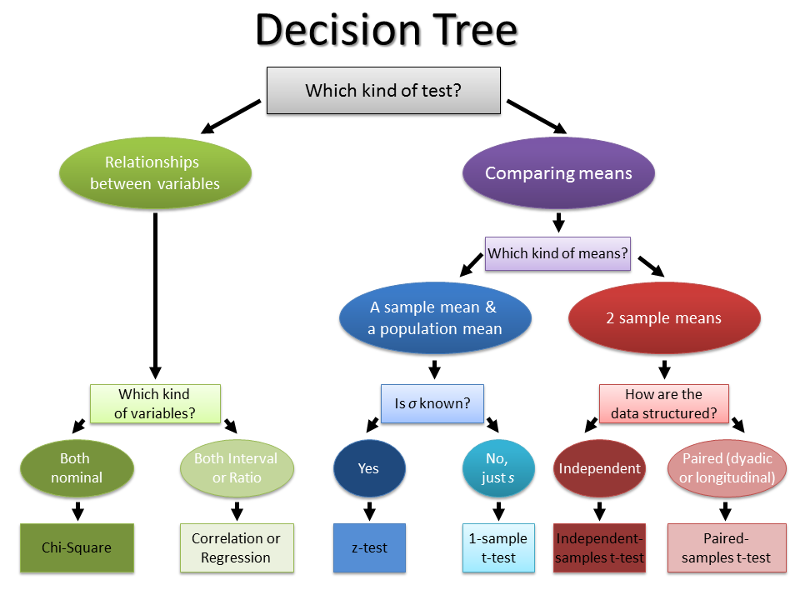
Recipes encourage poor practice

“If all you have is a hammer, everything looks like a nail”

  • violation of assumptions
    • especially: independence
  • discretization of predictors
  • treating categorical data as continuous
  • over-aggregation
  • mindless statistics

What do they have in common?

  • t-test
  • correlation & regression
  • multiple regression
  • analysis of variance
  • mixed-effects modeling
  • All are special cases of the General Linear Model (GLM).

GLM approach

  1. Define a mathematical model representing the processes that are assumed to give rise to the data
  2. Estimate the parameters of the model
  3. Validate the model
  4. Transparently report what you did
    • share your code
    • anonymize and share your data (ethics permitting)

Models are just… models

A statistical model is a simplification and idealization of reality that captures our key assumptions about the processes underlying data (the data generating process or DGP).

Importance of data simulation

  • Data simulation is a litmus test of understanding a statistical approach.
    • Can you generate simulated data that would meet the assumptions of the approach?
      • If not, you don’t understand it (yet!)
  • Being able to specify the DGP is key to study planning (power)

Example: Parent reflexes

Does being the parent of a toddler sharpen your reflexes?

  • simple response time to a flashing light
  • dependent (response) variable: mean RT for each parent

Simulating data

set.seed(2021) # RNG seed: arbitrary integer value
parents <- rnorm(n = 50, mean = 480, sd = 40)

parents
 [1] 475.1016 502.0983 493.9460 494.3853 515.9221 403.0972 490.4698 516.6227
 [9] 480.5509 549.1985 436.7118 469.0870 487.2798 540.3417 544.1788 406.3410
[17] 544.9324 485.2556 539.2449 540.5327 442.3023 472.5726 435.9550 528.3246
[25] 415.0025 484.2151 421.7823 465.8394 476.2520 524.0267 401.4470 422.0822
[33] 520.7777 423.1433 455.8187 416.6610 428.5627 421.8126 476.5172 500.1895
[41] 484.6555 550.4085 466.1953 564.8000 478.6249 448.3138 539.0206 450.9777
[49] 492.4952 507.6786

Control group

set.seed(2021) # RNG seed: arbitrary integer value
parents <- rnorm(n = 50, mean = 480, sd = 40)

parents
 [1] 475.1016 502.0983 493.9460 494.3853 515.9221 403.0972 490.4698 516.6227
 [9] 480.5509 549.1985 436.7118 469.0870 487.2798 540.3417 544.1788 406.3410
[17] 544.9324 485.2556 539.2449 540.5327 442.3023 472.5726 435.9550 528.3246
[25] 415.0025 484.2151 421.7823 465.8394 476.2520 524.0267 401.4470 422.0822
[33] 520.7777 423.1433 455.8187 416.6610 428.5627 421.8126 476.5172 500.1895
[41] 484.6555 550.4085 466.1953 564.8000 478.6249 448.3138 539.0206 450.9777
[49] 492.4952 507.6786
control <- rnorm(n = 50, mean = 500, sd = 40)

control
 [1] 479.9884 409.7652 501.7497 485.2473 461.5911 504.1507 517.0916 493.1807
 [9] 438.0344 439.7760 500.6417 492.5854 515.6773 469.7316 509.2567 460.6555
[17] 522.6032 564.6701 489.9214 457.7649 486.0707 498.2804 444.0978 559.6087
[25] 458.4245 490.5222 460.0343 444.2983 539.2802 514.4376 486.4996 474.2645
[33] 413.3246 525.3316 494.2034 450.3989 521.3584 436.4694 460.3614 519.3304
[41] 532.4247 488.2534 497.8617 529.4074 500.5994 495.1199 474.1291 465.2857
[49] 479.6520 416.8966

\(t\)-test

t.test(parents, control, var.equal = TRUE)

    Two Sample t-test

data:  parents and control
t = -0.5871, df = 98, p-value = 0.5585
alternative hypothesis: true difference in means is not equal to 0
95 percent confidence interval:
 -20.89804  11.35576
sample estimates:
mean of x mean of y 
 480.6351  485.4062 

Analysis of variance (ANOVA)

dat <- tibble(
  group = rep(c("parent", "control"), 
              c(length(parents), length(control))),
  rt = c(parents, control))

dat
# A tibble: 100 × 2
   group     rt
   <chr>  <dbl>
 1 parent  475.
 2 parent  502.
 3 parent  494.
 4 parent  494.
 5 parent  516.
 6 parent  403.
 7 parent  490.
 8 parent  517.
 9 parent  481.
10 parent  549.
# ℹ 90 more rows
summary(aov(rt ~ group, dat))    
            Df Sum Sq Mean Sq F value Pr(>F)
group        1    569   569.1   0.345  0.558
Residuals   98 161801  1651.0               

Regression

\[Y_i = \beta_0 + \beta_1 X_i + e_i\]

\[e_i \sim N(0, \sigma^2)\]

summary(lm(rt ~ group, dat))

Call:
lm(formula = rt ~ group, data = dat)

Residuals:
    Min      1Q  Median      3Q     Max 
-79.188 -27.147   3.214  29.341  84.165 

Coefficients:
            Estimate Std. Error t value Pr(>|t|)    
(Intercept)  485.406      5.746  84.472   <2e-16 ***
groupparent   -4.771      8.127  -0.587    0.558    
---
Signif. codes:  0 '***' 0.001 '**' 0.01 '*' 0.05 '.' 0.1 ' ' 1

Residual standard error: 40.63 on 98 degrees of freedom
Multiple R-squared:  0.003505,  Adjusted R-squared:  -0.006663 
F-statistic: 0.3447 on 1 and 98 DF,  p-value: 0.5585

Single- vs Multi-level data

sub A Y
1 A1 774
2 A1 845
3 A1 786
4 A2 751
5 A2 680
6 A2 805
sub stim A Y
1 A A1 787
1 B A1 530
1 C A1 743
2 A A2 859
2 B A2 849
2 C A2 787

Issues with multi-level data

  • GLMs assume independence of residuals
  • Observations within a cluster (unit) are not independent
  • Any sources of non-independence must be modeled (we’ll learn this later!) or aggregated away
  • Typical consequence of failing to do so: High false positives

Regression: Killer App

technique t-test ANOVA regression
Categorical IVs
Continuous DVs
Continuous IVs -
Multi-level data - -
Categorical DVs
Unbalanced data - -
>1 sampling unit

Four functions to rule them all

  1. Is the data single- or multi-level?
  2. Is the response continuous or discrete?
  3. How are the observations distributed?
structure response distribution R function
single cont normal base::lm()
single cont/disc various base::glm()
multi cont normal lme4::lmer()
multi cont/disc various lme4::glmer()